

💧 Why desalination is making a comeback
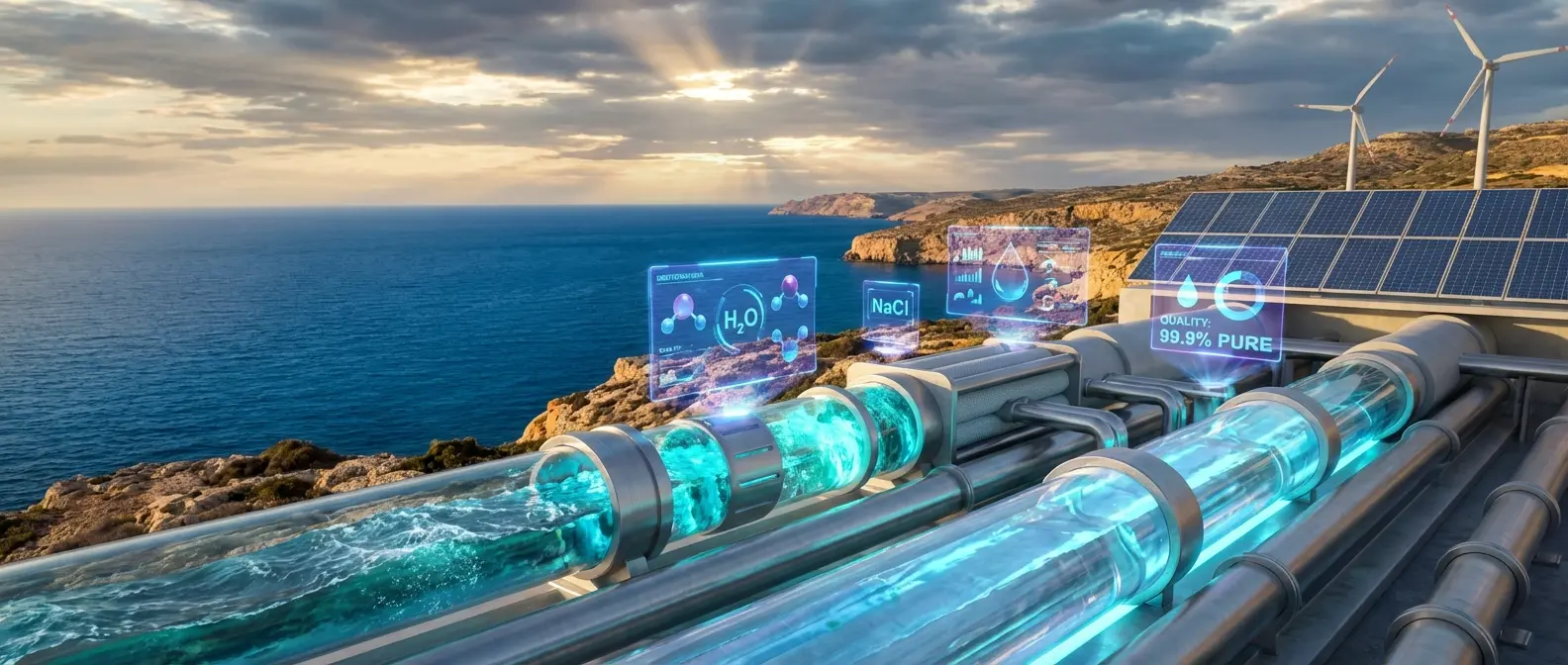
For decades, desalination was considered an expensive and energy-intensive solution. But three factors changed the equation:
Climate crisis
Droughts are more frequent and intense. Greece has experienced water crises on islands and the mainland in recent years. Desalination doesn't depend on rainfall.
Cheaper energy
Solar panels and wind energy have become cheaper. Desalination plants can now operate on renewables, dramatically reducing operating costs.
New membranes
New nanotechnology membranes require less pressure, meaning less energy, while lasting longer and needing less maintenance.
🔧 The new technologies
Reverse Osmosis (RO)
The most widespread method. Water is pushed through membranes that retain salt. New graphene oxide membranes reduce energy consumption by 20%.
Electrodialysis (ED)
Uses an electric field to separate salt ions. Ideal for brackish water and industrial applications. Lower consumption for low salinity.
Forward Osmosis (FO)
Uses natural osmosis instead of pressure. Much lower energy but requires draw solution separation. Under development for large-scale applications.
Solar Distillation
Uses sunlight directly for evaporation. New solar-thermal materials increase efficiency. Ideal for remote areas without electricity.

🇬🇷 The situation in Greece
Greece already has over 21 desalination plants, mainly on islands. Most are small-scale and serve local needs. New large-scale plants are being planned:
Santorini
Upgrade of existing plant
Mykonos
New plant powered by renewables
Rhodes
Largest in the country
Crete (Heraklion)
Under study - large scale
⚠️ The challenges
Desalination is not without its problems. The main concerns:
Brine discharge
The hyper-saline residue can harm marine ecosystems if not managed properly. New diffusion techniques mitigate the problem.
Energy intensity
Despite improvements, desalination remains energy-intensive. Coupling with renewables is critical for sustainability.
Upfront cost
Plants require significant upfront investment. EU funding and public-private partnerships facilitate the projects.
🔮 The future of desalination
Energy storage
Batteries will enable 24/7 operation with renewables.
Brine utilization
Extraction of lithium, magnesium, and other minerals from brine.
AI optimization
Algorithms will automatically adjust operations for maximum efficiency.
Desalination is no longer the last resort—it's a strategic tool for water security in the Mediterranean. With new membrane technologies and renewable energy integration, it's becoming cheaper, greener, and more accessible.
The sea can become a source of life—as long as we harness it responsibly.
OnOff Environment
We cover the technologies that address today's environmental challenges.