

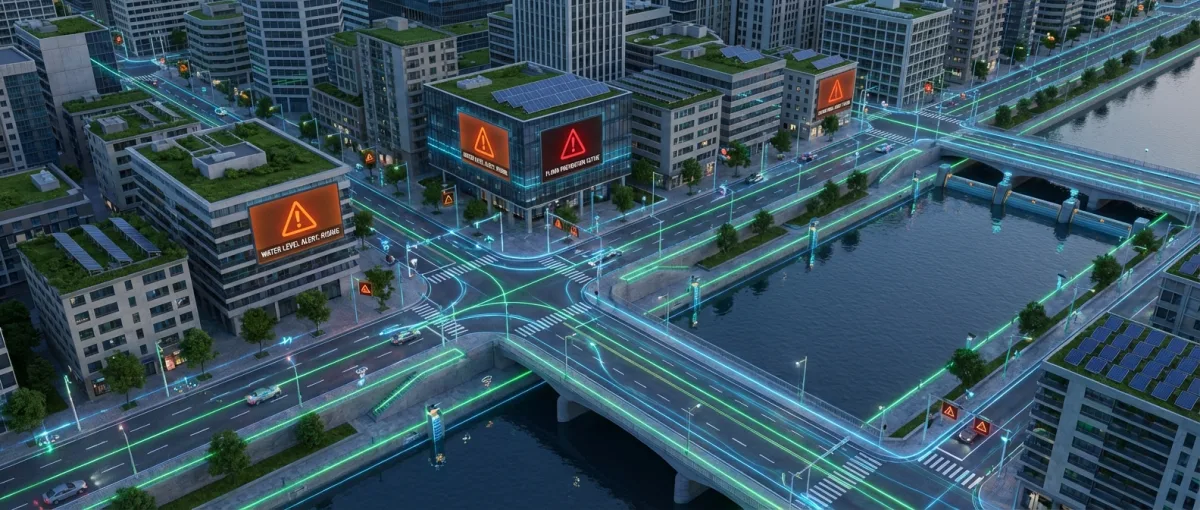
In November 2017, a wall of mud swept through Mandra, a town west of Athens, killing 24 people in a matter of hours. No warning system fired. No sensor existed. Eight years later, Greece is deploying hundreds of IoT flood sensors across Athens, Thessaloniki, and Western Attica — building a network that promises to predict flood risk before rising waters reach anyone's doorstep.
📖 Read more: New Satellite Tech Detects Wildfires in 15 Minutes
📡 How a Flood Sensor Network Works
The principle is simple, but scale is what matters. Small IoT sensors — each roughly the size of a shoebox — are installed at critical points: stream beds, underpasses, stormwater drains, bridges. They measure three things simultaneously: water level, rainfall intensity, and soil saturation.
Data is transmitted in real time — via 5G or NB-IoT — to municipal emergency centers. There, AI algorithms combine live readings with meteorological models and historical data to generate flood risk predictions 6 to 12 hours in advance.
Why it matters: Climate change has increased the frequency of flash floods in the Mediterranean by 40% over the past decade. Greece, with its mountainous terrain and urban streams buried under decades of unplanned development, is particularly vulnerable.
ℹ️ Athens: 200+ Sensors Along the Kifissos and Ilissos
The Attica Region has begun installing more than 200 sensors along the Kifissos and Ilissos river basins — two waterways that cut through some of the most densely populated areas and have a long history of overflows. The sensor network stretches from Kifissias Avenue all the way to the Faliron coast.
Each sensor costs between €15 and €50. That sounds cheap, but the real expense lies elsewhere: network maintenance, replacing units damaged by the very floods they monitor, and telecommunications connectivity. COSMOTE and Vodafone are providing the IoT infrastructure through dedicated M2M (machine-to-machine) contracts.
Integration With the 112 Emergency System
A critical innovation: the sensor system connects directly to Greece's Civil Protection agency and the 112 emergency alert system. When readings exceed danger thresholds, an automatic notification is sent to the crisis management center. From there, a 112 alert can be pushed to specific geographic zones — exactly like earthquake warnings, but for flooding.
"The goal isn't just to measure water levels. It's to give citizens reaction time before the water reaches their doors."
— Spokesperson, General Secretariat for Civil Protection
📖 Read more: 1000 Cameras in Athens: Security or Big Brother
🟢 Thessaloniki and the Thermaikos Gulf
Thessaloniki faces a different challenge: beyond the streams flowing from Mount Sheikh Sou, the city is also threatened by rising seawater levels in the Thermaikos Gulf. Coastal flood sensors are being deployed along the Nea Paralia waterfront and in eastern suburbs.
The operational model is backed by the EU's Horizon Europe programme, which funds “smart city flood resilience” projects across pilot cities. Thessaloniki was selected as one of ten European pilot cities for the scheme.
📌 Cities That Are Already Ahead
Copenhagen installed a flood sensor network back in 2018, after devastating floods in 2011 that caused €800 million in damage. Today, the system covers 100% of the urban area and automatically controls pumping stations, sluice gates, and relief tanks.
Amsterdam uses “digital twins” — virtual replicas of its water network — to simulate flood scenarios in real time. Tokyo, home to the world's most extensive underground flood defense system, operates over 10,000 sensors across a metropolitan area of 38 million people.
The European Push
The EU Climate Adaptation Strategy now explicitly targets sensor-based early warning systems. Greek municipalities that fail to invest now will find themselves locked out of European funding — and falling behind on core resilience benchmarks.

💡 What This Means for Residents
For anyone living in Athens or Thessaloniki, the sensor network translates into three concrete things:
First, fewer surprises. Instead of watching a stream flood with zero warning, you'll receive a mobile alert hours in advance.
📖 Read more: Athens: The Greek Institute of Human Genomics Launches
Second, faster emergency response. The Fire Service, EMAK rescue teams, and municipal crews will know exactly where to deploy resources — not after citizen calls, but before.
Third, data for long-term planning. Where are new stormwater drains needed? Which streams need to be cleared of illegal construction? Sensor data provides evidence-based answers.
Technical note: 5G connectivity enables sub-second data transmission (sub-second latency), which is critical for flash flood scenarios where every minute counts.
📝 The Real Challenge: Maintenance, Not Installation
Experience from Copenhagen and Tokyo reveals something Greek authorities have yet to fully confront: installation is the easy part. The real challenge is ongoing maintenance.
Sensors placed in stream beds are frequently destroyed by the very thing they measure — floods. Batteries die, antennas lose calibration, firmware needs updating. Without dedicated maintenance staff and a standing budget, a network of 200 sensors can quietly become a network of 50 working sensors within two years.
The Mandra tragedy must not be repeated. The technology now exists. The question is no longer whether sensors will be installed — but whether we'll ensure they're still working on the day we actually need them.