

Since 2018, when Apple integrated the electrocardiogram (ECG) sensor into the Apple Watch Series 4, millions of users worldwide have had access to clinical-grade measurements right from their wrist. But how reliable are these readings really? Let's examine the latest scientific data.
📖 Read more: Apple Watch Series 11 vs Ultra 3: Which Should You Choose in 2026?
What Exactly the Apple Watch ECG Measures
A standard hospital electrocardiogram uses 12 leads with 10 electrodes placed on the limbs and chest. This technique, originally developed by Willem Einthoven in 1903 (Nobel Prize 1924), provides a complete picture of the heart's electrical activity from 12 different angles.
The Apple Watch works entirely differently. It uses a single lead (Lead I), through two electrodes: one on the back of the watch (resting against the wrist) and one on the Digital Crown (which you touch with your opposite hand). The voltage is measured between the left and right hand — exactly like Lead I in a standard ECG.
Key Difference: While a standard 12-lead ECG provides information about myocardial rhythm, axis, ischemia, hypertrophy, and much more, the Apple Watch's single-lead ECG focuses primarily on detecting rhythm — and more specifically, atrial fibrillation (AFib).
What Clinical Studies Say
The Apple Heart Study (Stanford, 2019)
The largest study in the field was conducted in collaboration with Stanford University and included over 419,000 participants. The results were impressive:
- Only 0.52% of participants received an irregular rhythm notification
- Of those who received a notification and wore a Holter monitor, 84% actually had atrial fibrillation during monitoring
- The positive predictive value (PPV) ranged from 71–84%, depending on the analysis method
This means the Apple Watch doesn't “see” atrial fibrillation where it doesn't exist — but there's a small chance it may miss some episodes (false negative).
Sensitivity and Specificity
Based on clinical study data that led to FDA De Novo clearance (2018), the Apple Watch ECG algorithm shows:
What It Can and CAN'T Detect
✅ Can Detect:
- Atrial Fibrillation (AFib): The primary function — detects the absence of P waves and irregular R-R rhythm
- Sinus Rhythm: Confirms the heart is beating normally (60–100 bpm at rest)
- Bradycardia/Tachycardia: Records heart rate during the reading
- High resting heart rate: Alerts above 120 bpm or below 40 bpm
❌ CANNOT Detect:
- Heart Attack (Myocardial Infarction): Requires multiple leads to detect ST elevation or depression
- Atrial Flutter: The algorithm doesn't look for the characteristic “sawtooth” F waves
- Ventricular Tachycardia: Requires specialized multi-lead analysis
- Coronary Artery Blockages: Cannot replace a stress test or angiography
- Valve Disease: Requires cardiac echocardiogram
- Congenital Conduction Abnormalities: Wolff-Parkinson-White syndrome, Long QT, etc.
Which Models Support ECG
Not all Apple Watch models have an ECG sensor. The electrical heart sensor was introduced in the Series 4 (2018) and is included in every newer flagship model:
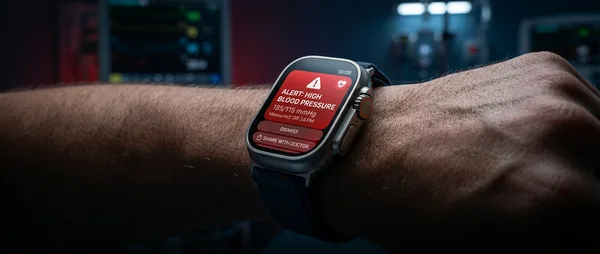
New 2025 Feature: The Apple Watch Series 11 introduced hypertension notifications, FDA-cleared. The feature was trained on 9,800 participants and analyzes the shape and speed of the pulse wave using a deep learning algorithm.
What Cardiologists Say
The medical community approaches the Apple Watch ECG with a positive but measured stance. The American Heart Association endorsed the ECG feature since Series 4, while the European Society of Cardiology recognizes the usefulness of smartwatches for AFib screening in people over 65.
However, experts consistently emphasize the following points:
- Screening, not diagnosis: The Apple Watch is a detection (screening) tool, NOT a diagnostic tool. Every finding must be confirmed by a doctor
- Single-lead ≠ 12-lead: A single-lead recording provides only one “window” into the heart. A doctor needs a full ECG for comprehensive evaluation
- False negatives: If atrial fibrillation is paroxysmal (comes and goes), the Apple Watch may not catch it at the exact moment it occurs
- Health anxiety: Some users develop excessive worry about their health, taking dozens of ECGs daily
Real Stories That Change Lives
Despite its limitations, there are countless stories of people whose Apple Watch helped detect problems before they became serious:
- Silent AFib Detection: Atrial fibrillation often presents no symptoms — but increases the risk of stroke fivefold. Early detection allows anticoagulant therapy
- Athletes: Several athletes discovered arrhythmias during training, potentially preventing fatal cardiac events
- Post-ablation monitoring: Patients who underwent atrial fibrillation ablation use the Apple Watch to monitor for recurrence
How to Get an Accurate ECG
ECG quality depends heavily on measurement conditions. Follow these tips for the most reliable results:
Step-by-Step for a Proper Reading
- Tighten the band: The watch should fit snugly on your wrist with no gap between the sensor and your skin
- Rest your arm on a table: Place your hand on a flat surface or on your lap — being still is critical
- Touch the Digital Crown: Press lightly with a finger from your opposite hand — don't press hard
- Stay still for 30 seconds: Don't move, don't talk — any movement creates signal noise
- Avoid measuring after exercise: Wait at least 5–10 minutes after physical activity
Why “Inconclusive”? About 12% of readings yield an “Inconclusive” (unclassifiable) result. The most common reasons: movement during measurement, a loose band, wrist tattoos (the ink interferes with optical sensors), or a very high or very low heart rate (below 50 or above 150 bpm).
ECG Apple Watch vs Medical Devices
How does the Apple Watch compare to the “gold standard” medical devices?
What the Future Holds
Apple continues to invest heavily in health features. Here are some developments that are expected or already in testing:
- Hypertension notifications (2025): Already available on Series 11 with FDA clearance. Trained on 9,800 participants
- Blood oxygen sensor (restored): In August 2025, Apple restored the SpO2 feature via iOS 18.6.1 / watchOS 11.6.1, with data processing on the iPhone instead of the watch (to avoid Masimo's patent)
- Sleep apnea detection: FDA-approved in September 2024, available on Series 9+ and Ultra 2+
- Blood glucose monitoring: Under development — expected in future generations
- AI-enhanced ECG analysis: The Neural Engines in newer chips (S9, S10) are paving the way for more advanced on-device analysis
Frequently Asked Questions
Can the Apple Watch ECG detect a heart attack?
No. The Apple Watch records only Lead I, which isn't sufficient for detecting a myocardial infarction. A full 12-lead ECG in a hospital setting is required. If you experience chest pain, call emergency services immediately.
Should I show my Apple Watch ECGs to my doctor?
Absolutely! You can export your ECGs as PDFs through the Health app on your iPhone. This gives your cardiologist information they wouldn't otherwise have — especially if you experience paroxysmal (intermittent) arrhythmia.
Is it accurate if I have a wrist tattoo?
Tattoos can affect the optical sensors (heart rate, SpO2), but the electrical ECG sensor is less impacted. However, you may receive more “Inconclusive” results.
How often should I take an ECG?
There's no specific recommendation. If you feel palpitations, dizziness, or a fluttering sensation, take an ECG right away. Otherwise, once a week is more than enough for screening purposes. Avoid excessive use, which can lead to unnecessary anxiety.
Is the ECG feature available in my country?
The Apple Watch ECG feature is available in over 60 countries and regions. It requires watchOS 5.2+ and iOS 12.2+ (or later), along with an Apple Watch Series 4 or newer. Check Apple's feature availability page for your specific country.
Conclusion
The Apple Watch ECG is a remarkably accurate screening tool for atrial fibrillation, with 98.3% sensitivity and 99.6% specificity according to FDA data. It is not — and doesn't try to be — a replacement for a clinical 12-lead electrocardiogram.
Its real value lies in its constant availability: you can take an ECG at the exact moment you feel something concerning, without waiting for an appointment. This capability, combined with data from an estimated 267.6 million Apple Watches sold worldwide (2023 estimate), creates an unprecedented population-level cardiac monitoring network.
Remember: The Apple Watch is your best “first filter.” If you receive an AFib notification or see concerning results, see a cardiologist immediately. Atrial fibrillation affects over 33 million people worldwide and increases the risk of stroke fivefold — early detection saves lives.