

📖 Read more: Blood Pressure on Apple Watch: Activation Guide
What Is VO2 Max?
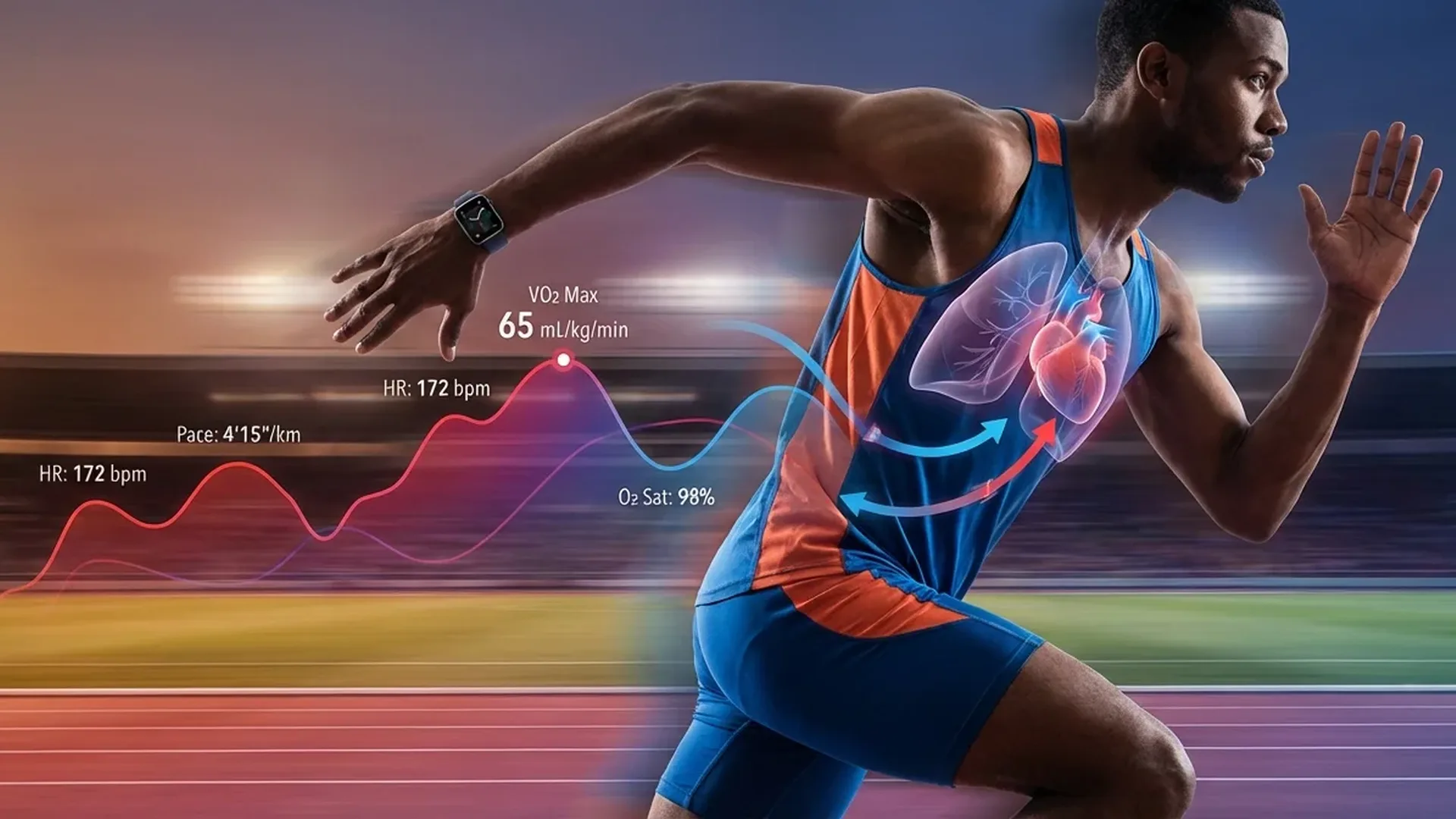
VO2 Max (Volume of Oxygen Maximum) represents the maximum amount of oxygen your body can consume during intense physical activity. It is measured in milliliters of oxygen per kilogram of body weight per minute (ml/kg/min) and is considered the gold standard for measuring cardiorespiratory fitness worldwide.
In simple terms, the higher your VO2 Max, the more efficiently your body transports and utilizes oxygen during exercise. A high VO2 Max means your heart pumps more blood per beat, your lungs absorb a greater volume of oxygen, and your muscles use it more effectively to produce energy. Elite endurance athletes typically have VO2 Max values above 60 ml/kg/min, while the average sedentary adult may sit between 25 and 35.
Traditionally, measuring VO2 Max required a visit to a sports medicine laboratory, where you would wear a gas analysis mask while exercising on a treadmill or stationary bike. The procedure cost between €100 and €300 per session and was impractical for regular monitoring. Now, Apple Watch brings this measurement to your wrist at no additional cost.
How Apple Watch Estimates VO2 Max
Apple Watch estimates your VO2 Max by analysing your heart rate data combined with motion data during outdoor walks, runs, or hikes. It utilises the optical heart rate sensor, GPS, accelerometer, and barometric altimeter to calculate how hard your heart is working relative to the intensity of your activity.
Apple's algorithm factors in your age, sex, weight, and height — information you enter in the Health app. To receive reliable readings, you need at least 20 minutes of continuous outdoor exercise at a steady or gradually increasing pace. The measurement does not work indoors, as GPS data is required for accuracy. The cardio fitness metric on Apple Watch has received FDA clearance, certifying that Apple's algorithm meets clinical accuracy standards for use as a consumer health monitoring tool.
Tips for Accurate Readings
For the best results, do outdoor workouts of at least 20 minutes on flat or gently inclined terrain. Make sure the Watch sits snugly on your wrist, about 1–2 finger widths above the wrist bone. Keep your health data (weight, height, age) up to date in the Health app, and start with a 5-minute warm-up before your main workout.
The Four Cardio Fitness Levels
Apple Watch categorises your VO2 Max into four Cardio Fitness levels, based on your age and sex:
- Low: Below expectations for your demographic group. Apple sends a notification if you fall into this range, as it is associated with increased cardiovascular risk.
- Below Average: Lower than the general population average but not considered alarming. It signals room for improvement through regular exercise.
- Above Average: Good condition. Most active people who exercise regularly fall into this category.
- High: Excellent cardiorespiratory fitness, typical of athletes or people with intensive aerobic training programmes.
Average VO2 Max by Age Group
VO2 Max values vary significantly by age and sex. For men aged 20–29, the average ranges from 35 to 50 ml/kg/min, while endurance athletes can reach 55–70+. For women of the same age, the average is 28–42 ml/kg/min. After age 40, a natural decline of approximately 1% per year is expected, although regular exercise can significantly slow this reduction.
For men aged 40–49, healthy levels range between 30 and 45 ml/kg/min. After 60, values above 30 are considered very good. For women over 50, values above 25 ml/kg/min indicate good cardiovascular health. These ranges are based on clinical data and are regularly updated by Apple to reflect the latest research.
Why VO2 Max Matters for Longevity
VO2 Max is considered one of the strongest predictors of longevity. Clinical studies show that individuals with high VO2 Max have significantly lower risk of cardiovascular disease, type 2 diabetes, and premature death. The American Heart Association (AHA) now classifies cardiorespiratory fitness as a vital sign — placing it at the same level of importance as blood pressure, cholesterol, and blood sugar levels.
A consistently declining VO2 Max trend can serve as an early warning sign of declining health, even before clinical symptoms appear. This is precisely why Apple enabled Low Cardio Fitness notifications: if your VO2 Max drops to low levels for your age group, you receive an alert on your wrist encouraging you to discuss your results with a doctor.
How to Improve Your VO2 Max
Improving your VO2 Max requires training consistency and proper progressive overload. The most effective approach combines steady-state aerobic exercise with high-intensity interval training (HIIT). Here are proven strategies:
- Steady-state cardio (Zone 2): Running, cycling, or swimming 3–5 times per week for 30–60 minutes at moderate intensity where you can still hold a conversation.
- Interval training (HIIT): 1–2 sessions per week. Short bursts of high intensity (30 seconds to 4 minutes) alternating with recovery periods of easy activity or rest.
- Hill repeats: Running uphill forces your body to consume more oxygen and simultaneously strengthens muscular endurance.
- Progressive overload: Increase duration or intensity by <10% per week to avoid injury and allow proper adaptation.
- Sleep and nutrition: Your body improves during rest. Adequate sleep (7–9 hours) and proper hydration are critical components of any improvement plan.
Results take time. You can expect a 5–15% improvement within 4–8 weeks of consistent training. The most significant changes typically become visible after 3–6 months, which is why long-term tracking through Apple Watch is so valuable. The trends matter far more than any single reading.
📖 Read more: watchOS 26: Complete Features Guide
Tracking Trends in the Health App
Don't fixate on individual measurements — a single bad reading doesn't mean anything on its own. The real value of VO2 Max on Apple Watch lies in long-term trends. Check the charts in the Health app under Cardio Fitness to see whether your fitness is improving, holding steady, or declining over weeks and months.
Accuracy: Apple Watch vs Lab Testing
According to published research, Apple Watch demonstrates approximately 95% accuracy compared to laboratory VO2 Max measurements (spirometry during graded exercise testing). This means the estimate may deviate by 1–3 ml/kg/min from the true value — an acceptable margin of error for everyday health monitoring.
Lab testing remains the gold standard for absolute accuracy, but it costs €100–€300 per session and is impractical for regular monitoring. Apple Watch offers weekly estimates at no cost, which proves far more useful for the average person who wants to observe trends rather than obtain a single precise number.
Factors That Affect Your Reading
Several factors can influence the accuracy of your VO2 Max measurement on Apple Watch. Understanding these helps you interpret your values correctly:
- Altitude: At high elevations (above 1,500 metres), reduced oxygen pressure can produce lower readings without any actual decline in your fitness level.
- Temperature: Heat increases heart rate, leading to a lower VO2 Max estimate. Cold weather may produce slightly more favourable readings.
- Medication: Beta-blockers and other heart-rate-altering medications can significantly skew results. Consult your doctor if you take these regularly.
- Fatigue and illness: If you feel unwell or are exhausted, the reading will likely be lower than your baseline.
- Caffeine and alcohol: Caffeine can modestly increase heart rate, while alcohol consumption can elevate it noticeably the following day.
Low Cardio Fitness Notifications
Since watchOS 7, Apple Watch can notify you if your VO2 Max drops to low levels. The feature automatically analyses your data and compares it against expected ranges for your age and sex. To enable these notifications, open the Health app on your iPhone, go to Browse, select Heart, then Cardio Fitness, and toggle on Low Cardio Fitness Notifications.
If you receive a Low Cardio Fitness notification, don't panic immediately. The decline may be due to temporary factors such as a viral infection, excessive fatigue, or changes in medication. If the trend persists for several weeks, it is worth discussing with your doctor and starting a structured fitness improvement programme.
Frequently Asked Questions
How often does VO2 Max update?
Apple Watch updates its VO2 Max estimate after each qualifying outdoor workout. If you exercise regularly outdoors, you will see weekly updates. It does not update during indoor workouts because GPS data is unavailable.
Which Apple Watch models measure VO2 Max?
VO2 Max is supported on Apple Watch Series 3 and later, as well as all SE and Ultra models. You need watchOS 7 or later for Low Cardio Fitness notifications and detailed trend charts.
Why don't I see a VO2 Max reading?
If you don't see a value, you likely haven't completed a long enough outdoor workout. You need at least 20 minutes of Outdoor Walk, Run, or Hike via the Workout app. Also ensure your health details (age, weight, sex) are up to date in the Health app.
Can I improve my VO2 Max after age 50?
Absolutely. Regardless of age, regular aerobic exercise can improve your VO2 Max. Progress may be slower compared to younger individuals, but it is entirely achievable. Studies show improvements greater than 15% even in people over 60 years old.
How accurate is it compared to Garmin?
All wearable devices use estimation algorithms — none replace lab testing. However, Apple, Garmin, and COROS produce values close to clinical measurements, with deviations of 1–5 ml/kg/min. The most important thing is to track trends within the same device rather than comparing absolute values between different brands.
Does weight loss affect VO2 Max?
Yes, significantly. Because VO2 Max is measured per kilogram of body weight (ml/kg/min), losing weight — especially body fat — tends to increase your VO2 Max even if your absolute oxygen consumption stays the same. This is another reason why maintaining a healthy weight improves this metric.