

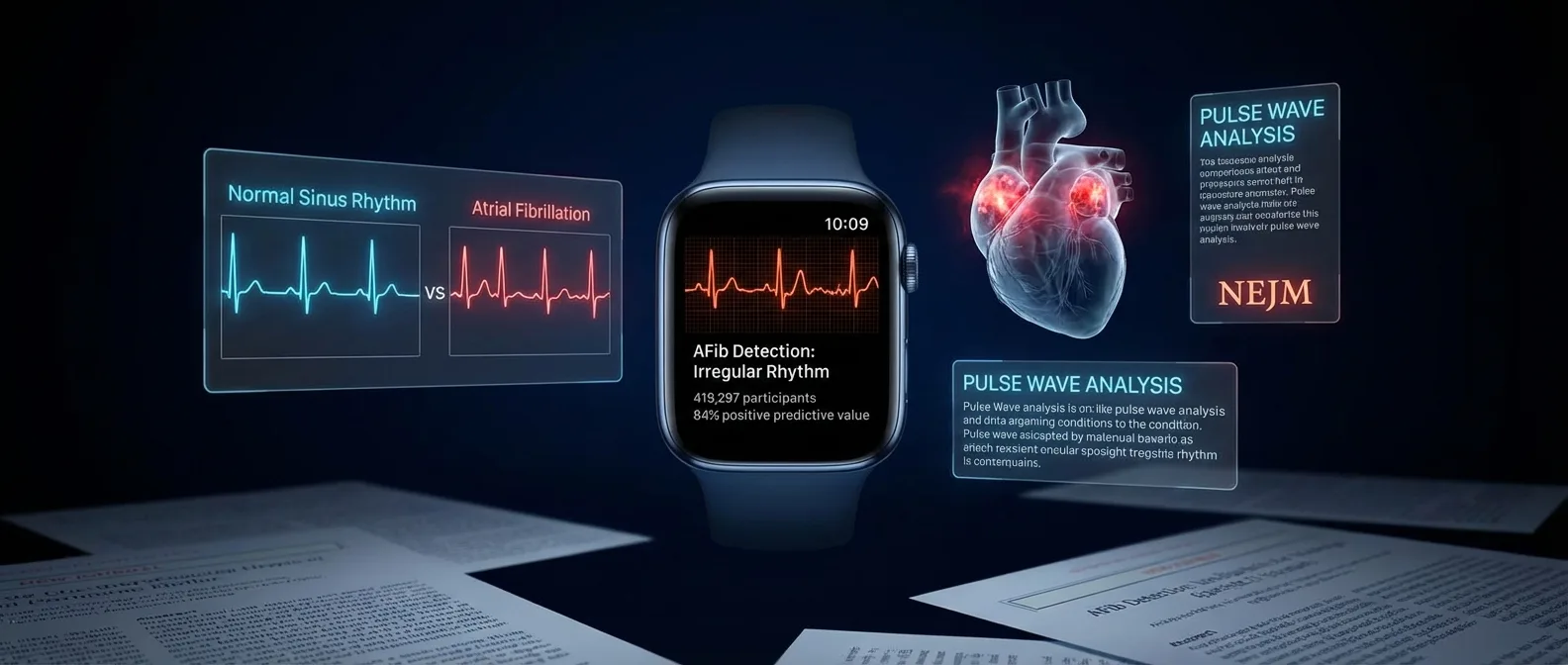
A study published in the New England Journal of Medicine — one of the most trusted medical journals in the world — reveals impressive data on the Apple Watch's ability to detect atrial fibrillation.
📖 Read more: Apple Watch AFib After Ablation: New Clinical Study
With 419,297 participants and a positive predictive value of 84%, the Apple Heart Study is one of the largest digital clinical trials in history. What does this mean for you? Let's break down the findings step by step.
What Is Atrial Fibrillation (AFib) and Why Should You Care?
Atrial fibrillation (AFib) is the most commonly diagnosed clinically significant cardiac arrhythmia. It affects approximately 6 million people in the US alone, with a lifetime risk of up to 1 in 3 individuals. In Europe, millions more live with the condition, many of them undiagnosed.
The truly alarming part? Atrial fibrillation increases the risk of stroke five-fold. And because it often occurs in paroxysmal form (meaning it comes and goes), it may not be detected during a routine electrocardiogram (ECG) at a doctor's office. Estimates suggest that approximately 700,000 people in the US are living with undiagnosed atrial fibrillation.
Irregular Rhythm
The heart's atria “quiver” instead of contracting normally, causing an irregular heartbeat.
Stroke Risk
AFib increases stroke risk by 5 times due to blood clot formation.
"Silent" Condition
It often occurs without symptoms or in brief episodes that go undetected.
This is where technology enters the picture. A smartwatch on your wrist, continuously monitoring your heart rate, could theoretically catch those paroxysmal arrhythmias that a standard ECG would never detect. But can a watch truly compete with medical equipment? The Apple Heart Study answers this question.
The Apple Heart Study: The Largest Digital Clinical Trial
The Apple Heart Study was published in the New England Journal of Medicine (NEJM) — one of the top peer-reviewed medical journals worldwide — and represents a milestone in the field of digital health. Let's look at the key facts:
Participants
From all 50 US states
Positive Predictive Value
Of irregular pulse notifications
Days of Monitoring
Average monitoring duration
Months of Enrollment
November 2017 – August 2018
How the Study Was Designed
The study was designed by researchers at Stanford University in collaboration with Apple, following a pioneering “siteless” methodology. This means that no participant needed to visit a clinic — everything was conducted via smartphone, smartwatch, and home-delivered medical devices.
Methodology in 4 Steps:
The Apple Watch's PPG sensor passively monitors the pulse and generates 1-minute tachograms.
📖 Read more: Apple Watch vs Galaxy Watch 7: 2026 Comparison
If multiple irregular tachograms are detected, the user receives an irregular pulse notification.
A telehealth visit is conducted and an ECG patch (ePatch) is mailed for up to 7 days of wear.
ECG patch data is analyzed by two independent clinicians, with a third in case of disagreement.
An important detail: data analysis was performed by independent Stanford statisticians, independently of Apple's funding. Apple owns the data, but Stanford has the right to publish regardless of results — which strengthens the study's credibility.
The Surprising Results
Who Received Notifications?
Out of 419,297 participants, only 2,161 (0.52%) received an irregular pulse notification over a median monitoring period of 117 days. This may seem like a low rate, but it's by design: the algorithm was built to minimize false positives.
Notification Rate by Age Group
Source: Apple Heart Study, NEJM 2019 — Perez MV et al.
The significant difference by age is expected: atrial fibrillation is much more common in older adults. However, even the 0.16% rate among younger people represents individuals who likely would never have been detected through traditional methods.
The Critical Metric: Positive Predictive Value
The most important metric from the study is the positive predictive value (PPV) — that is, how often a notification actually corresponded to atrial fibrillation.
What does 84% PPV mean?
It means that in 84% of cases, when the Apple Watch sends an irregular pulse notification, it is confirmed as actual atrial fibrillation by a simultaneous clinical ECG. This is an exceptionally high rate for a device without electrodes.
Why the 34% “Yield” Doesn't Mean Failure
A commonly misunderstood point: only 34% of notified individuals showed atrial fibrillation on the ECG patch they wore afterward. Seems low? In reality, it doesn't mean the remaining notifications were wrong.
Atrial fibrillation is paroxysmal — it occurs in episodes. The ECG patch was applied on average 13 days after the initial notification. During that interval, the arrhythmia may well have temporarily resolved. Furthermore, among irregular tachograms without AFib, the following were found:
Premature atrial contractions (≥6 in 3 minutes) — a condition that can progress to AFib.
Three or more consecutive atrial beats — a condition requiring clinical evaluation.
Premature ventricular contractions (≥6 in 3 minutes) — a finding that warrants monitoring.
In other words, even notifications that didn't correspond to AFib were associated with other arrhythmias requiring medical attention. The algorithm detects “something abnormal,” and in the vast majority of cases, it is indeed clinically relevant.
Impact on the Healthcare System
A critical question was: what do people do when they receive a notification? Do they ignore their watch or seek medical help?
📖 Read more: AI Disease Diagnosis: How Apple Watch Data Trains Models
90-Day Survey Results (1,376 responses)
The numbers speak for themselves: 76% of notified individuals contacted a doctor (either the study's telehealth physician or their own). Among those who reported a new AFib diagnosis, 18% underwent ablation and 24% received electrical cardioversion — serious therapeutic interventions that might never have occurred without the watch's notification.
What Do Critics Say?
No study is perfect, and the researchers were transparent about the limitations:
Sensitivity Not Measured
The study was not designed to measure how many AFib cases were missed (false negatives). It only measures how many notifications were correct.
Demographic Skew
Participants were predominantly younger — reflecting Apple Watch owner demographics, not the general population.
Low ECG Patch Return Rate
Only 450 out of 2,161 notified participants (20.8%) returned an ECG patch — fewer than expected.
ECG Patch Delay
Average patch application was 13 days later — paroxysmal AFib may no longer have been present.
It's worth noting, however, that Apple itself acknowledges that the absence of a notification does not rule out arrhythmia. The algorithm does not detect short AFib episodes, and the feature should not be used as a population screening tool — at least not yet.
How AFib Detection Works on Apple Watch Today
Since the time of the study (2017-2018), the technology has evolved significantly. Today, the Apple Watch offers three different methods for detecting cardiac arrhythmias:
1. Irregular Rhythm Notification (Passive)
The PPG sensor periodically checks your pulse in the background. If multiple irregular tachograms are detected, you receive a notification. No action needed — it works automatically. Available: Series 1+
2. ECG App (On-Demand)
Place your finger on the Digital Crown for 30 seconds. The app generates a full Lead I electrocardiogram. It can classify the rhythm as normal or AFib and produce a PDF for your doctor. Available: Series 4+
3. AFib History (Monitoring)
For users with diagnosed AFib, the Apple Watch tracks the time you spend in atrial fibrillation (AFib burden). It displays weekly estimates in the Health app. Available: Series 4+ with watchOS 9+
Availability & Regulatory Approvals
Both the Irregular Rhythm Notification and the ECG app have FDA clearance in the US and CE marking in Europe. According to the official watchOS Feature Availability page, both features are available in over 150 countries worldwide.
The AFib History feature is also available in a very large number of countries, essentially covering every market where the Apple Watch is sold. This means that users worldwide have access to all AFib detection tools without geographic restrictions.
📖 Read more: Focus Mode: Notification Filters Guide
Apple Watch vs Traditional Detection Methods
How does a $399 watch compare to traditional AFib detection methods? Let's take a look:
The Apple Watch's strength doesn't lie in the accuracy of a single ECG — the traditional 12-lead clearly excels there. It lies in continuous, passive monitoring: a sensor that never gets tired, never forgets, and checks your heart rhythm hundreds of times a day.
Real-Life Rescue Stories
The Apple Heart Study isn't the only evidence. For years, stories have emerged of people claiming that the Apple Watch saved their lives. Tim Cook, Apple's CEO, regularly shares such stories:
Asymptomatic Detection
"I felt nothing. No dizziness, no palpitations. But my watch alerted me 3 times in one week. I went to the cardiologist and was diagnosed with paroxysmal AFib."
— Typical case of an asymptomatic patient
Young Athlete
"I'm 28 years old, I run marathons. I would never have gone to a cardiologist. The ECG notification led me to an ablation that changed my life."
— Young athlete with silent AFib
What This Means for You
If you wear an Apple Watch, you already have on your wrist an AFib detection tool backed by a study of 419,000+ people published in a peer-reviewed medical journal. But there are a few things to keep in mind:
What It DOES Well
- ✅ Detects AFib passively, 24/7
- ✅ 84% PPV — extremely reliable
- ✅ On-demand ECG on your wrist
- ✅ PDF report for your doctor
- ✅ Minimizes false positives
What It DOESN'T Do
- ❌ Doesn't replace a clinical ECG
- ❌ Doesn't always detect brief episodes
- ❌ Doesn't guarantee 100% accuracy
- ❌ Not a screening tool
- ❌ No notification ≠ healthy
Important Reminder
If you receive an irregular rhythm notification or an ECG result showing “atrial fibrillation,” don't panic — but don't ignore it. Schedule an appointment with your cardiologist. Export the PDF from the Health app (Health → Heart → Electrocardiograms → Export) and bring it with you.
What Does the Future Hold?
The Apple Heart Study was just the beginning. Apple is now running the Apple Heart and Movement Study, a long-term study leveraging newer Apple Watch models with ECG, SpO2, temperature, and now blood pressure sensors. Meanwhile, independent research teams around the world are using Apple's ResearchKit for their own studies.
With each new generation of hardware and every algorithm upgrade, accuracy improves. The Apple Watch Series 11, with its upgraded PPG sensor and new blood pressure feature, represents yet another step toward an era where prevention happens on your wrist, not just in the doctor's office.
The Apple Heart Study proved something fundamental: a commercial smartwatch can reliably detect atrial fibrillation — with an 84% positive predictive value, across 419,297 participants, in a peer-reviewed NEJM publication. This isn't speculation or marketing. It's science.
The Science Speaks
419,297 participants. 84% positive predictive value. Published in the New England Journal of Medicine. AFib detection on the Apple Watch isn't a gadget — it's clinically validated technology.
Source: Perez MV, Mahaffey KW, et al. “Large-Scale Assessment of a Smartwatch to Identify Atrial Fibrillation.” N Engl J Med 2019;381:1909-1917. DOI: 10.1056/NEJMoa1901183